I
The Recognition
Why does someone sometimes feel familiar before we know them?

It can happen in a doorway. You have no history with this person, and still the body answers as if a history were already there. Relief, sometimes. Sometimes unease. People call it recognition because that is what it feels like: not discovery, but return.
The feeling is real as a feeling. That is the beginning of the inquiry, not the end of it. A feeling can be precise and still be about more than the other person. It can be memory. It can be hope. It can be the moment an inner image finds a face.
The chapters that follow do not vote on your experience. They ask what human beings have done with this one, and where a beautiful account starts to speak for someone who has not agreed to the story.
Sources
- The opening stays with experience on purpose. The studies of familiarity, attachment, and idealization are in The Mirror. They are not introduced here as a verdict.
- All images were created by Grok.
II
Before We Had Names
What did the old stories think a person was, before the cut?
Twin flame myths is the name people bring to this room. The stories here are older than that name, and they do not agree with one another.
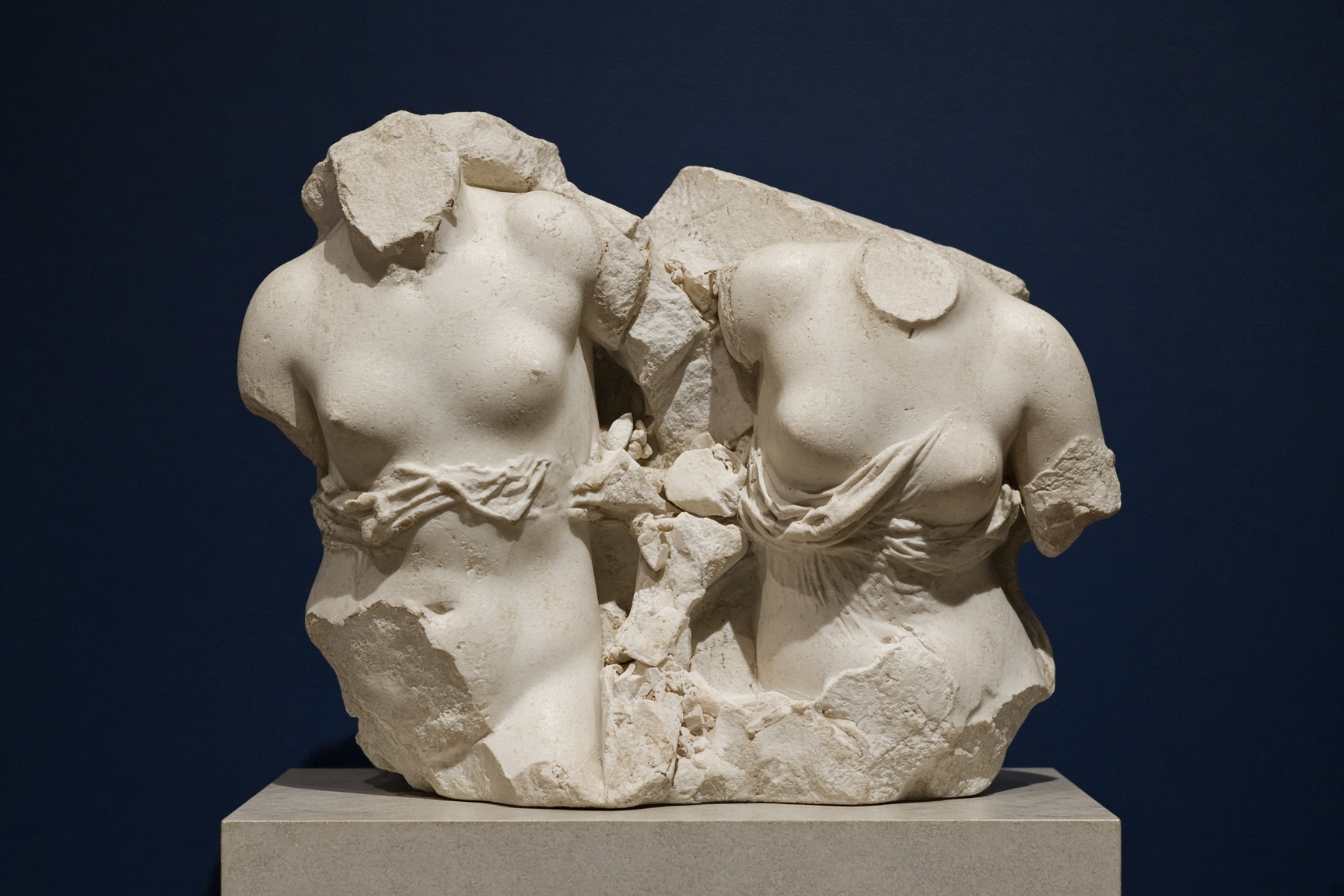
Not a historical object.
Plato’s comedy of the cut
In the Symposium, written in the early fourth century BCE, the speeches in praise of eros do not agree. Aristophanes, the comic poet, tells the one people remember. Human beings were once round, terrible in strength, with four arms, four legs, and two faces. Some were male, some female, and some androgynos, a share of both. They assaulted heaven. Zeus cut them.
For love is the desire of the whole, and the pursuit of the whole is called love.
After the cut, each desired the other half. They clung and neglected the rest of life, and Zeus, pitying them, turned their bodies so that embrace could also be a way back to living.
Aristophanes compares the split person to a symbolon, the broken token by which two parties recognize each other. He is not filing a report. He is telling a myth at a drinking party, and the dialogue does not let his myth have the last word.
The other account, in the same dialogue
Socrates reports Diotima. She has heard the story that lovers seek their other half. She refuses it as a full account.
They are seeking neither for the half of themselves, nor for the whole, unless the half or the whole be also a good.
In her telling, eros wants the good, and the ongoing possession of it, and it climbs: from one beautiful body toward beauty itself. Reunion of a lost half and ascent toward beauty are both in the Symposium. They are not the same theory.
A midrash, not a copy
Bereshit Rabbah, a rabbinic commentary gathered in the land of Israel roughly between the third and fifth centuries CE, reads the verse “male and female God created them.” Rabbi Yirmeya ben Elazar says the first human was created androgynos. Rabbi Shmuel bar Nachman says the first human was made with two faces, then sawn, so that there was a back on each side.
When others object with the verse about a rib, he hears the Hebrew tzela as side, the same word used for the side of the tabernacle.
The image resembles Aristophanes. It is not the same story. The midrash is arguing inside scripture about the first human and about gender in the verse. It is not a Greek comedy about hubris, and it is not a doctrine that your missing half is a person you have not met. Readers have noticed the resemblance for a long time. Resemblance is not identity.
A short rendering of Bereshit Rabbah 8:1
Rabbi Yirmeya ben Elazar said: when the Holy One created the first human, God created that human androgynous, as it is written, male and female God created them.
The English follows Joshua Schreier’s translation in the Sefaria Midrash Rabbah. The Hebrew is the text. This panel is a glimpse, not a substitute.
Sources
- Plato. Symposium. Translated by Benjamin Jowett. 3rd ed. Oxford: Oxford University Press, 1892. The sentences quoted are from Aristophanes’ speech and from Socrates’ report of Diotima. Greek text: Platonis Opera, ed. John Burnet. Oxford: Oxford University Press, 1903. Stephanus pages 189c to 193d for Aristophanes, and about 205e for Diotima’s refusal of the half.
- Bereshit Rabbah 8:1. Translated by Joshua Schreier. In The Sefaria Midrash Rabbah, edited by Michael Siev and Yaacov Francus. Sefaria, 2022. Bereshit Rabbah 8:1. The Posen Library notes the resemblance to Plato and the difference of framework.
III
The Souls Before Birth
What, if anything, is decreed?
Babylonian Talmud, Sotah 2a
Fortydays
before an embryo is formed,a heavenly voice is said to speak.
The daughter of so-and-so to so-and-so.This house for that one.This field for that one.
A first match
The saying is received as a decree. A first zivug, announced before the body is formed. The grammar of the sugya is a daughter matched to a man, and a house, and a field. It is not a modern map of every love.
A second match
The same page says a match is as difficult as the splitting of the sea, and that this difficulty follows a person’s deeds. The Talmud does not throw one sentence out. The voice and the conduct are given different jobs.
Is love something decreed,something discovered,or something two people create?
Zivug
Hebrew for a pairing, a match. In Sotah 2a the first pairing and the second are not the same claim. Later speech sometimes flattens both into “your person.”
Bashert
Yiddish for what is meant, often one’s intended. It lives near zivug and is not the technical term of the sugya. Writers inside the tradition say a person may not marry a first match, and that people are not shown the ledger.

Jewish tradition does speak about matches, and it does not speak in one voice. In Bereshit Rabbah 68:4 a Roman matron asks Rabbi Yosi ben Halafta what God has been doing since creation. Matching couples, he says. She thinks this is easy, pairs the people she controls, and by morning the pairs have come apart in injury.
The midrash is blunt about force. A pairing made against the people in it does not hold. The scene also sits inside a world of slavery. That is part of the text, not a detail to tidy away.
Later mysticism goes further, and it argues with itself. In the Zohar, Lech Lecha 32, souls that are to be born stand before God in pairs. They are formed male and female, then separated as they come into the world, and joined again at marriage, “as at first.”
The same passage will not leave the picture alone. A proclamation is questioned. A wife, it says, is also what a man deserves. If he lives virtuously he may marry “his own true mate.” Matching is called difficult even for God. The grammar is a man’s search for a wife.
It is not a modern map of every kind of love, and it is not a permission slip. A summary in circulation gives the separating souls to Zohar, Tazria 5. That section does not say it. The passage read here is Lech Lecha 32.
Traditional readers receive the Zohar as the teaching of Rabbi Shimon bar Yochai, in the second century. The scholarly consensus, since Gershom Scholem, is that the book is a medieval composition, chiefly late thirteenth-century Castile, associated with Moses de León, drawing on earlier material. Both facts belong in the room.

Sources
- Bereshit Rabbah 68:4. The matron and Rabbi Yosi ben Halafta. Bereshit Rabbah 68:4.
- Babylonian Talmud, Sotah 2a. William Davidson Talmud. Sefaria. Sotah 2a. The forty days are not forty-two. The sugya distinguishes zivug rishon and zivug sheni.
- Zohar, Lech Lecha 32. Soncino translation on Sefaria. Souls stand in pairs, separate, and may be joined “as at first,” with the merit clause in the same section. Zohar, Lech Lecha 32. For the dating: Gershom Scholem, Major Trends in Jewish Mysticism (New York: Schocken, 1941). Traditional attribution remains Rabbi Shimon bar Yochai. A circulating summary assigns the pairs to Zohar, Tazria 5. The Sefaria text of that section does not say what the summary claims. Lech Lecha 32 does.
- On whether everyone marries a first match, later authorities disagree, and several say the matter is not visible to us. See the discussion gathered from Sotah 2a, Moed Katan 18b, and the Zohar in responsa and commentaries, rather than a single rule.
IV
The Language of Love
Which word are we actually using?
The words feel like a family. They were not born in one house.
A Greek comedy
A Jewish argument
One divine body
Written in English
A later teaching
A soul friend
A name for a state
A relation two people make
No older house
Sources
- Each entry is expanded in the chapters around it. Plato and Bereshit Rabbah are in Before We Had Names. Zivug and bashert are in The Souls Before Birth. Corelli and the later teaching are in The Modern Flame. Tennov is in The Mirror.
- Ardhanārīśvara is included so it will not be flattened. A standard orientation is Encyclopaedia Britannica, “Ardhanarishvara,” and the Shaiva iconographic tradition. It is not a source for the modern twin-flame doctrine.
- Twin ray follows the Summit Lighthouse account, in which Mark L. Prophet and Elizabeth Clare Prophet use twin ray and twin flame for one claim. See The Path to Attainment, the chapter “Twin Rays,” and Elizabeth Clare Prophet, Soul Mates and Twin Flames. The movement’s own summary is the TSL Encyclopedia entry “Twin flame.” A later popular split between the two names is not in that account.
- Karma as action and consequence is older than the romance category. Helena P. Blavatsky, The Key to Theosophy, treats karma as a link in a universal law, not as a kind of couple. No single first text for the phrase “karmic relationship” turned up. It is not a clinical term.
- John O’Donohue, Anam Cara: A Book of Celtic Wisdom (New York: HarperCollins, 1997). He gives anam as soul and cara as friend, and he places the early use in the Celtic church, as a guide to whom one could speak openly.
- Marguerite Porete, The Mirror of Simple Souls, about 1300. The clarified soul mirrors divine love. It is not a source for the recent phrase “mirror soul.” No first text for that couple-phrase was found. “Divine counterpart” likewise has no older technical use in the texts consulted here.
- 1 Samuel 18:1. “The soul of Jonathan was knit with the soul of David.” The sentence is a friendship. It is not the origin of the modern compound “soul bond,” for which no single first text was found.
V
The Mirror
What does another person awaken in us?

Psychology does not have a test for a destined counterpart. It does have a vocabulary for how recognition can feel inevitable and still be made of ordinary human processes, stacked until they feel like fate.
One stack is memory. Familiarity and recollection are not the same act. A face, a voice, a way of standing can strike the sense of “I know this” before any story arrives to explain it.
Robert Zajonc showed that mere exposure can warm a preference before a person can say why. That is not the whole of love. It is enough to keep “I have always known you” from being treated as a plain report.
Another stack is attachment. John Bowlby described the bond that keeps a young child close to a protector, and the panic when that bond is uncertain. Cindy Hazan and Phillip Shaver later asked whether adult romance borrows the same pattern: nearness, protest at separation, and a person who becomes a base. An anxious history can make a small sign of interest feel enormous. That, too, is a description, not an insult.
Limerence is something that happens. It is not a decision. It is not yet a life with someone.
Dorothy Tennov’s name for the involuntary state is limerence: intrusive thought, idealization, and a mood that swings on whether the other person seems to want you back. Uncertainty feeds it. She thought it often lasted months to a few years, and sometimes became a steadier affection, and sometimes did not.
Calling a storm by its name does not tell you to leave the person. It tells you the storm is not the same thing as a mutual life.
C. G. Jung, in “Marriage as a Psychological Relationship” (1925), argued that much of what feels like immediate knowledge of a partner is unconscious. A psychological relationship, in his sense, begins where two people can see each other, not only the image each is carrying. The other person may awaken a real part of you. Awakening is not ownership.
C. Raymond Knee’s work on destiny beliefs and growth beliefs is useful here because it studies the story, not the soul. People who believe a relationship is either meant to be or it is not tend to let early satisfaction decide the future more sharply, and to cope with trouble by treating the bond as already wrong.
People who believe a relationship is cultivated are more likely to stay with the difficulty. Neither belief proves a metaphysical match. Both change what a person does on an ordinary Tuesday.
Sources
- Yonelinas, Andrew P. “The Nature of Recollection and Familiarity: A Review of 30 Years of Research.” Journal of Memory and Language 46, no. 3 (2002): 441–517.
- Zajonc, Robert B. “Attitudinal Effects of Mere Exposure.” Journal of Personality and Social Psychology 9, no. 2, pt. 2 (1968): 1–27.
- Bowlby, John. Attachment and Loss. Vol. 1, Attachment. New York: Basic Books, 1969.
- Hazan, Cindy, and Phillip Shaver. “Romantic Love Conceptualized as an Attachment Process.” Journal of Personality and Social Psychology 52, no. 4 (1987): 511–24.
- Tennov, Dorothy. Love and Limerence: The Experience of Being in Love. New York: Stein and Day, 1979. The limerence is involuntary, not a quotation of a single line.
- Jung, C. G. “Marriage as a Psychological Relationship.” First published 1925. In The Development of Personality, vol. 17 of The Collected Works of C. G. Jung. Princeton, NJ: Princeton University Press, 1954.
- Knee, C. Raymond. “Implicit Theories of Relationships: Assessment and Prediction of Romantic Relationship Initiation, Coping, and Longevity.” Journal of Personality and Social Psychology 74, no. 2 (1998): 360–70.
VI
The Modern Flame
When did this become a teaching?
The ancient stories are about division, desire, and decree. “Twin flame,” as a phrase with a community around it, is modern. The chronology is a development, not a proof that each step caused the next.

Not Corelli’s edition. The pages are not a source.
- A Romance of Two Worlds
Marie Corelli, whose name was Mary Mackay, publishes a romance. The character Heliobas says a soul is dual, “like half a flame that seeks the other half,” and he uses the compound Twin-Flame. It is a documented early literary use. It is spoken inside fiction, by a man who also claims he can command his companion spirit. The novel is not a history of ancient doctrine.
- The Summit Lighthouse
Mark L. Prophet founds the Summit Lighthouse, in a line of American esoteric teaching that runs through Helena Blavatsky and the I AM movement of Guy and Edna Ballard. Twin flames, in this world, are a pair of souls, often described as masculine and feminine counterparts, not necessarily the person one has married.
- Elizabeth Clare Prophet
Elizabeth Clare Wulf meets Mark Prophet in 1961, marries him in 1963, and continues the work after his death in 1973. The Church Universal and Triumphant is established in 1975. In that teaching Mark and Elizabeth are themselves called twin flames. Marriage on earth, the movement said, might be with a soulmate or with someone joined by karma, and not always with the twin flame.
- A different vocabulary
Tennov publishes Love and Limerence in the same decades, from psychology rather than from ascended masters. The two languages sometimes get glued together later. They did not start as one research program.
- Runner and chaser
Contemporary communities add runner and chaser: one person withdraws, the other pursues, and the pursuit is sometimes taught as a spiritual assignment rather than as a response to a boundary. That interpretation matters. It can turn “no,” silence, or an ended relationship into a test the pursuer is required to pass. Nothing in Plato, in Sotah, or in Corelli’s novel establishes that duty.
Sources
- Corelli, Marie. A Romance of Two Worlds. London: Richard Bentley and Son, 1886. The Twin-Flame passage is Heliobas speaking to the narrator. A public-domain text is on Project Gutenberg.
- “Church Universal and Triumphant / Summit Lighthouse.” World Religions and Spirituality Project. Virginia Commonwealth University, 2018. Summit Lighthouse and Church Universal and Triumphant. Mark Prophet founds the Summit Lighthouse in 1958. The church is dated to 1975. Twin flame is an internal teaching, including the claim about Mark and Elizabeth.
- Runner and chaser is reported here as contemporary community language, not as a single canonical book. The ethical weight of that language is taken up in the next chapter, with the research on control and spiritual pressure.
VII
Love Without Erasure
What is a feeling not allowed to decide?
Reciprocity is not a demand that love be returned. It is the difference between a profound experience in one person and a relationship two people make. You can love someone and be wrong about what they feel. The second fact limits what the first is allowed to do.
A belief in a spiritual connection does not, by itself, make a relationship unhealthy. Wonder is still allowed. A belief that someone is your destined partner does not establish their consent, and it does not justify harm.
When one person withdraws, more than one reading is available. A community may call it a stage, the runner teaching the chaser to wait. Psychology may call it an attachment pattern, or simple incompatibility. It may also be a wish, plainly spoken by absence: this person does not want this bond.
Those readings can sit beside one another. None of them cancels the other person’s autonomy. Silence is not a syllabus. A no does not become a test because the pursuer has a story ready for it.
Destiny language becomes harmful when it overrides that no, explains cruelty as a lesson the injured person ordered, or sells certainty to someone already in pain. The same words can stay tender when both people remain free to leave the script.
Former members of Twin Flames Universe, the group led by Jeff and Shaleia Divine, have described coaching, rank, and assigned pursuit. The 2023 documentary Escaping Twin Flames gathers those accounts. The leaders dispute them.
The midrash already knew something like the limit, from the other direction. The matron’s forced matches did not become marriages because she had arranged them. Diotima will not call a half good merely because it is yours.
Love can be mysterious without requiring us to abandon discernment.
Sources
- Stark, Evan. Coercive Control: How Men Entrap Women in Personal Life. New York: Oxford University Press, 2007. The book is about a pattern of domination. It is not a study of twin-flame communities. It is cited for the pattern, which sacred language can be asked to serve.
- Johnson, David, and Jeff VanVonderen. The Subtle Power of Spiritual Abuse. Minneapolis: Bethany House, 1991. An early pastoral account of sacred language used to shame and control. Later clinical writing has continued the inquiry. This walk does not treat one book as the whole field.
- Peck, Cecilia, director. Escaping Twin Flames. Netflix, November 8, 2023. Former members allege manipulation, coerced pursuit, and commercial teaching inside Twin Flames Universe. Jeff and Shaleia Divine dispute the portrait. The series is testimony and investigation, not a judgment of a court. Reporting around the release noted that related criminal charges had not been filed.
- The ethical reading of Bereshit Rabbah 68:4, Sotah 2a, and Symposium 205e is this walk’s, and it is marked as a reading. The texts are cited in the earlier chapters.
VIII
What Makes a Whole?
Is union the recovery of something lost, or something two whole beings create?

Aristophanes answers one way. The cut was a loss, and love is the pursuit of the whole. Diotima answers another. A half is not worth seeking unless it is good, and love has further to go than the recovery of an old shape.
The Talmud refuses a single mechanism. A first match may be announced. A life is still lived by deeds. A modern teaching sometimes chooses the first answer and then forgets that the person across from you is not a myth.
Two lights can travel toward each other and remain two. What becomes possible then is not fusion. It is a relation: consent, return, argument, care, the daily decision to stay or to go. The name for that relation is reciprocity. It is not a bill for the love to be paid back. Wholeness, if the word still helps, may be what each person brings, not what one person borrows by disappearing.
What if union is not the disappearance of two into one,but the discovery of what becomes possiblewhen two remain fully themselves?
IX · A limit, not a license
What Science Can Carry
What can two remain, if neither is the center?
Science cannot tell you who your person is. It can tell you which sentences break when they are asked to carry a soul. Three limits belong here. They are analogies with a hard edge, and they are marked as analogies.
A bound state
Two bodies in orbit do not take turns being the center. They move about a point that belongs to the pair. The relation has a mass of its own, smaller than either body: μ = m₁m₂ / (m₁ + m₂). A bound state costs energy to hold, and it can unbind. Leaving is not, by itself, a failure of destiny.
A nearness that tears
In 1849 Édouard Roche showed that a fluid satellite, inside a critical distance, cannot keep its shape. For equal densities that distance is about 2.44 radii of the body being orbited. Inside it, tides win. Nearness is not a good with no edge. The limit is astronomical. What it refuses is the teaching that closer is always truer.
No second copy
In 1982 William Wootters and Wojciech Zurek showed that an unknown quantum state cannot be cloned. A person is not a quantum state. The theorem still forbids one popular sentence: that someone is your identical other half, a second copy waiting in the world.
The miss, kept in the room
Entanglement is real, and it is not a way to send a feeling. The correlations are not a channel. You cannot use them to summon, to inform, or to overrule a silence. Pair annihilation is the other miss. An electron and a positron can meet and become light, and both are gone. That is erasure, not a wedding.
A conjecture that entangled black holes are joined by a wormhole is a neighbor, about black holes. It is not a bridge between two people, and it is not placed here as one.
Sources
- The reduced mass μ = m₁m₂ / (m₁ + m₂) is the standard two-body relation of classical mechanics. It is cited as a picture of a relation, not as a finding about any couple.
- Roche, Édouard. “La figure d’une masse fluide soumise à l’attraction d’un point éloigné.” Mémoires de la section des sciences 1. Académie des sciences et lettres de Montpellier, 1849. He gives about 2.44 planetary radii for a fluid satellite of the same density. George Howard Darwin later refined the figure to about 2.455.
- Wootters, William K., and Wojciech H. Zurek. “A Single Quantum Cannot Be Cloned.” Nature 299 (28 October 1982): 802–3. Dennis Dieks, “Communication by EPR Devices,” Physics Letters A 92 (1982): 271–72, reached the related limit the same year. Persons are not the systems the theorem describes.
- Einstein, Albert, Boris Podolsky, and Nathan Rosen. “Can Quantum-Mechanical Description of Physical Reality Be Considered Complete?” Physical Review 47 (1935): 777–80. John S. Bell, “On the Einstein Podolsky Rosen Paradox,” Physics Physique Fizika 1 (1964): 195–200. Entanglement does not provide a signaling channel.
- Maldacena, Juan, and Leonard Susskind. “Cool Horizons for Entangled Black Holes.” Fortschritte der Physik 61, no. 9 (2013): 781–811. Named only to be left out. The conjecture is about black holes.
X · A wink, not a warrant
Familiar
What if the word for already-known were carrying both numbers?
Familiar comes from Latin familiaris, of the household, from familia. The stranger who feels like kin is already inside the word. In English ordinal the letters sum to 69. In full reduction the same letters sum to 42. One spelling. Two faces. A pleasure, and not a summons.
- 1Familiar
- 2Other half
- 3Longing
- 4Reunion
- 5Union
- 6Wholeness
English Ordinal
69
Full Reduction
42
The British spelling enamoured is 42 by full reduction. Drop the u, and enamored misses that face. It lands on 42 only in reverse reduction. The wink moves when one letter moves. That is the fun, and it is also the warning.
Wholeness 42 Reverse reductionEternal wholeness 69 Full reduction
42 · recognition, reunion
- LongingFull reduction
- ReunionFull reduction
- EnamouredFull reduction
- Other halfReverse reduction
- Coming homeReverse reduction
- Soulmate bondFull reduction
69 · love, union, devotion
- RomanceEnglish ordinal
- ReciprocityFull reduction
- Twin ray unionReverse reduction
- Twin flames unionFull reduction
- Cosmic love storyFull reduction
- Love is the answerFull reduction
What kind of universe are we living in where “love is the answer” = 69, and what, if anything, are we supposed to make of that?
Full Reduction
Love is the answer
69
Explore the full cipher field
- TwinReverse ordinal
- EternalReverse reduction
- ReunitedFull reduction
- ReflectedFull reduction
- Soul bondReverse reduction
- Pure loveFull reduction
- HomecomingReverse reduction
- TendernessFull reduction
- Endless loveFull reduction
- Beloved soulFull reduction
- Sacred flameFull reduction
- Soulful bondFull reduction
- Shared soulsFull reduction
- Souls unitedFull reduction
- Soulful trustFull reduction
- Mutual heartsFull reduction
- InseparableReverse reduction
- Sacred heartReverse reduction
- Mutual soulsReverse reduction
- Destined soulReverse reduction
- Kindred unionReverse reduction
- Timeless loveReverse reduction
- Romantic loveReverse reduction
- Heart and soulReverse reduction
- Boundless loveReverse reduction
- The red stringReverse reduction
- Love frequencyFull reduction
- Divine romanceFull reduction
- Mirrored soulsFull reduction
- Shared devotionFull reduction
- One sacred loveReverse reduction
- Beloved harmonyFull reduction
- Union of heartsReverse reduction
- Twin flame bondReverse reduction
- Everlasting loveFull reduction
- Cosmic encounterFull reduction
- Return to onenessFull reduction
- Love and devotionFull reduction
- Beloved resonanceFull reduction
- Two souls in unionFull reduction
- Two souls reunitedFull reduction
- One soul two bodiesFull reduction
Sources
- Full reduction is the Pythagorean chart: A through I are 1 through 9, then J returns to 1. The letters are summed and left as they stand, so 42 and 69 are not folded again to a single digit. Reverse reduction uses the reversed chart, A = 8, B = 7, through I = 9, and the pattern repeats. English ordinal is A = 1 through Z = 26. Reverse ordinal is A = 26 through Z = 1.
- Familiar, adjective. Latin familiaris, “of the household,” from familia. The English word arrives through Old French with the sense of intimacy and of being already known. Etymology is cited for the meaning of the word, not as a cause of the sums.
- Every phrase in the two lists was summed before it was printed. Enamoured in full reduction is 42. Enamored in full reduction is 39, and in reverse reduction is 42. The miss is the American spelling’s failure to keep the same face.